
Island Peak Climbing Nepal: The Complete Guide to Climbing Imja Tse (6,189m)
16th Jul, 2026
- annapurnaencounter
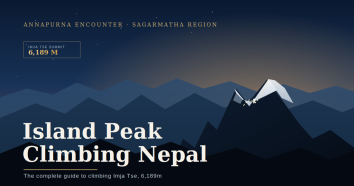
If you've ever stood in the Khumbu and looked up at a sharp, glacier-streaked pyramid rising above Chhukung, you've already met Island Peak. Officially named Imja Tse, Island Peak is Nepal's most popular trekking peak, and for good reason — it delivers a genuine Himalayan mountaineering experience, complete with fixed ropes, a headwall, and a summit ridge with 360-degree views of Lhotse, Nuptse, Makalu, and Everest itself, without demanding technical climbing experience or a full expedition budget.
Table of Contents
At Annapurna Encounter, Island Peak Climbing is one of our most requested adventures, and this guide covers everything you need to know before you commit: the route, the itinerary, the cost, the difficulty, the best season, and how it compares to nearby options like Mera Peak and Everest Base Camp.
What Is Island Peak (Imja Tse)?
Island Peak sits at 6,189 meters (20,305 feet) in the Sagarmatha (Everest) region, just south of Lhotse and Nuptse. British mountaineer Eric Shipton's 1953 expedition team named it "Island Peak" because, viewed from Dingboche, it appears as an island rising out of a sea of ice. Its Sherpa name, Imja Tse, is the name still used on official Nepal Mountaineering Association permits.
Unlike the eight-thousanders that dominate this region, Island Peak is classified as a trekking peak (Group A), meaning it requires a climbing permit but not the elaborate logistics or six-figure budget of an 8,000m expedition. It is, however, a real mountain: the final push involves a glacier crossing, a steep headwall fixed with ropes, and exposed ridge walking at altitude.
Why Climb Island Peak?
- Genuine summit experience — snow, ice, crevasses, and a headwall, all achievable in roughly 2-3 weeks
- World-class acclimatization route — the approach follows the Everest Base Camp trail through Namche, Tengboche, and Dingboche
- Spectacular summit views — Lhotse's south face, Ama Dablam, Makalu, Baruntse, and the Everest massif
- A natural stepping stone toward bigger objectives like Ama Dablam, Baruntse, or 8,000m peaks
- No prior technical climbing required, provided you train and hire a qualified climbing guide
Island Peak Climbing Difficulty
Island Peak is graded Alpine PD+ to AD-, making it moderately technical. Trekkers with strong fitness and no mountaineering background successfully summit every season, but it is not a walk-up. Expect:
- Steep snow and ice slopes near the summit (up to 45-55 degrees)
- A short but demanding headwall requiring jumar (ascender) use on fixed ropes
- Crevasse crossings on the glacier, usually with ladders or snow bridges
- A narrow, exposed summit ridge with drops on both sides
- Summit push starting around midnight for a sunrise or early-morning summit, in freezing temperatures
Good cardiovascular fitness, prior high-altitude trekking (EBC or Annapurna Circuit is ideal preparation), and comfort with exposure make the biggest difference. A few days of basic climbing training at Island Peak Base Camp — using crampons, ice axe, jumar, and harness — is built into every professional itinerary and is enough for most trekkers to climb safely with a guide.
Best Season for Island Peak Climbing
Spring (March–May) and autumn (late September–November) are the two prime windows.
- Spring: Stable weather, blooming rhododendrons on the lower trail, and the Everest region at its liveliest.
- Autumn: The most popular season — crisp, clear skies post-monsoon and excellent summit visibility.
Winter climbs are possible for experienced, cold-tolerant climbers but involve extreme temperatures. Monsoon season (June–August) is avoided due to poor visibility and unstable snow conditions.
Island Peak Climbing Itinerary (Base Camp to Base Camp)
Most operators, including Annapurna Encounter, run Island Peak as an 18–20 day base-camp-to-base-camp program departing from Kathmandu. A representative itinerary:
| Day | Route | Altitude |
|---|---|---|
| 1 | Fly Kathmandu → Lukla, trek to Phakding | 2,610m |
| 2 | Phakding → Namche Bazaar | 3,440m |
| 3 | Acclimatization day in Namche | 3,440m |
| 4 | Namche → Tengboche | 3,860m |
| 5 | Tengboche → Dingboche | 4,410m |
| 6 | Acclimatization day in Dingboche | 4,410m |
| 7 | Dingboche → Chhukung | 4,730m |
| 8 | Chhukung → Island Peak Base Camp | 5,087m |
| 9 | Base Camp: climbing training (crampons, ice axe, jumar, ladder crossing) | 5,087m |
| 10 | Base Camp → High Camp | ~5,600m |
| 11 | Summit push (Imja Tse, 6,189m) → descend to Chhukung | 4,730m |
| 12 | Reserve/buffer day for weather or extra acclimatization | — |
| 13 | Chhukung → Pangboche/Pheriche (optional side trip toward EBC) | — |
| 14–16 | Return trek via Namche to Lukla | 2,840m |
| 17 | Fly Lukla → Kathmandu | 1,400m |
| 18 | Departure / free day in Kathmandu | — |
Many climbers combine this with a side trip to Everest Base Camp and Kala Patthar, extending the trip to around 21–22 days — a highly popular combination we can arrange as a custom itinerary.
Island Peak Climbing Cost
Island Peak costs vary by group size, season, and inclusions, but as a general benchmark for a base-camp-to-base-camp package from Kathmandu, budget roughly USD 2,200–3,500 per person for a small group departure. Costs depend heavily on:
What typically drives the price:
- Nepal Mountaineering Association (NMA) climbing permit fee
- Sagarmatha National Park entry and local (rural municipality) permits
- Experienced climbing guide/Sherpa fees (often a dedicated climbing guide beyond the trekking guide)
- Group climbing gear (fixed ropes, ladders) and personal gear rental if needed
- Domestic flights (Kathmandu–Lukla–Kathmandu)
- Full-board accommodation and meals during the trek and at base camp
- Porters/yaks for gear transport
Typically excluded:
- International airfare and Nepal visa fees
- Personal climbing gear (boots, harness, crampons, ice axe — rentable in Kathmandu)
- Travel insurance with high-altitude rescue/evacuation coverage
- Tips for guides and porters
- Personal expenses (Wi-Fi, hot showers, extra snacks, bar bills)
We tailor final pricing to your group size, dates, and whether you want to combine Island Peak with EBC, Mera Peak, or Ama Dablam base camp trekking.
Island Peak vs. Mera Peak
A common question we get: should I climb Island Peak or Mera Peak? Both are 6,000m trekking peaks, but they suit different climbers:
- Mera Peak (6,476m) is technically easier — mostly a snow walk with less exposure — but sits higher and is more remote, with a longer approach through the Hinku Valley.
- Island Peak is shorter to access (via the Everest Base Camp trail), more technical near the summit (headwall, ridge, glacier), and pairs naturally with an EBC extension.
Some climbers combine both in a single expedition, crossing the Amphu Labtsa Pass between the two — a serious, technical undertaking suited only to well-prepared, experienced trekkers with a strong guide team. We can arrange this combined Mera Peak and Island Peak expedition on request.
Permits Required
- Nepal Mountaineering Association (NMA) Climbing Permit for Imja Tse — cost varies by season (highest in spring, lowest in winter)
- Sagarmatha National Park Entry Permit
- Khumbu Rural Municipality Entry Permit (replaced the former TIMS card in this region)
All permits are arranged by your operator ahead of the trip.
Essential Gear for Island Peak
Beyond standard high-altitude trekking gear (down jacket, sleeping bag rated to -20°C or lower, trekking poles), climbers need mountaineering-specific equipment:
- Plastic or insulated mountaineering boots compatible with crampons
- Crampons, ice axe, climbing harness, and locking carabiners
- Ascender (jumar) and descender/figure-8
- Climbing helmet
- Gaiters, glacier glasses/goggles, and insulated climbing gloves
Most of this can be rented in Kathmandu's Thamel district, which keeps costs manageable if you're a first-time climber.
Training and Preparation
You don't need prior mountaineering experience, but you do need to prepare:
- Cardiovascular endurance — hiking, running, or stair training for 2-3 months beforehand
- Leg strength — squats, lunges, and weighted hikes
- Prior altitude exposure — a previous trek above 4,000-5,000m (EBC, Annapurna Circuit) significantly improves your acclimatization curve
- Basic technical familiarity — even a single day of practice with crampons and jumar use (which we provide at base camp) makes the summit push far less intimidating
Is Island Peak Right for You?
Island Peak Climbing suits trekkers who have completed at least one high-altitude trek, are in strong physical condition, and want a real taste of Himalayan mountaineering without committing to a multi-month 8,000m expedition. It's an achievable, unforgettable summit for motivated first-time climbers — and a satisfying warm-up peak for those eyeing bigger objectives down the road.
Ready to climb Imja Tse? Annapurna Encounter runs Island Peak Climbing as a private, fully customizable departure — combine it with Everest Base Camp, adjust your dates, or bring your own group. Contact us for a tailored itinerary and quote.
Recent From Travel Guide
.jpg)
18th Jan, 2023
_11zon.jpg)
18th Jan, 2023
18th Jan, 2023
18th Jan, 2023

8th Dec, 2023
9th Dec, 2023
.jpg)
11th Feb, 2025
13th Dec, 2023
_11zon.jpg)
18th Dec, 2023
.jpg)
.jpg)
2nd Jan, 2024
3rd Jan, 2024
.jpg)
_11zon.jpg)
_11zon.jpg)
23rd Jun, 2025

24th Jan, 2024
.jpg)
30th Jan, 2024

4th Feb, 2024

5th Feb, 2024
-4.jpg)
6th Feb, 2024
.jpg)

12th Feb, 2024
.jpg)
_11zon.jpg)
18th Feb, 2024
.png)
-1.jpg)
7th Mar, 2024
.jpg)
12th Mar, 2024
13th Mar, 2024
20th Mar, 2024
.jpg)
26th Mar, 2024
-1.jpg)

14th Jan, 2025

14th Jan, 2025
16th Jan, 2025

18th Jan, 2025

20th Jan, 2025

24th Jan, 2025
.jpg)

5th Feb, 2025

5th Feb, 2025
9th Feb, 2025
3rd Apr, 2025
.jpg)
11th Apr, 2025
16th Apr, 2025
20th Apr, 2025
-1.jpg)
.jpg)
27th May, 2025
14th Jun, 2025

15th Jun, 2025
17th Jun, 2025
18th Jun, 2025
19th Jun, 2025
23rd Jun, 2025
24th Jul, 2025

3rd Sep, 2025
26th May, 2026
.jpg)
10th Jul, 2026
.png)
11th Jul, 2026